

By road:
· From Madrid via the southern entrance (recommended route), take the A-5 motorway (Extremadura Highway), exit 227 toward Jaraicejo. In Jaraicejo continue on the EX-385, then at the junction take the EX-208 to the right toward Torrejón el Rubio. Continue for 6 km to Monfragüe National Park (264 km).
· From Madrid via the northern entrance, take the A-5 motorway (Extremadura Highway), exit 185 onto the EX-A1 toward Plasencia. On the EX-A1, take exit 29 toward Monfragüe. Caution! Take great care on the final stretch: once you leave the EX-A1, the road is narrow and deer frequently cross at night (244 km).
· From Cáceres, take the EX-390 to Torrejón el Rubio. From there, take the EX-208 junction to the left toward Monfragüe (56 km).
· From Plasencia, take the EX-208 to Monfragüe (30 km).
· From Trujillo, take the EX-208 to Monfragüe (46 km).
By public transport:
· From the Monfragüe Railway Station, take the EX-208 road to Monfragüe National Park (16 km).
· There are bus services from Plasencia, Trujillo, and Torrejón el Rubio. Please check timetables with the bus companies.
WHAT TO SEE IN MONFRAGÜE
8 essential to do in Monfragüe
1) Take a guided birdwatching tour with some of the local ecotourism companies.
2) Visit the Salto del Gitano and go up to the Castle.
3) Discover new experiences with local companies: bike routes, hiking trails, birdwatching and photography hides, night routes…
4) Explore one of the 3 hiking routes within the Park, don’t forget water, wear proper footwear and start a little early.
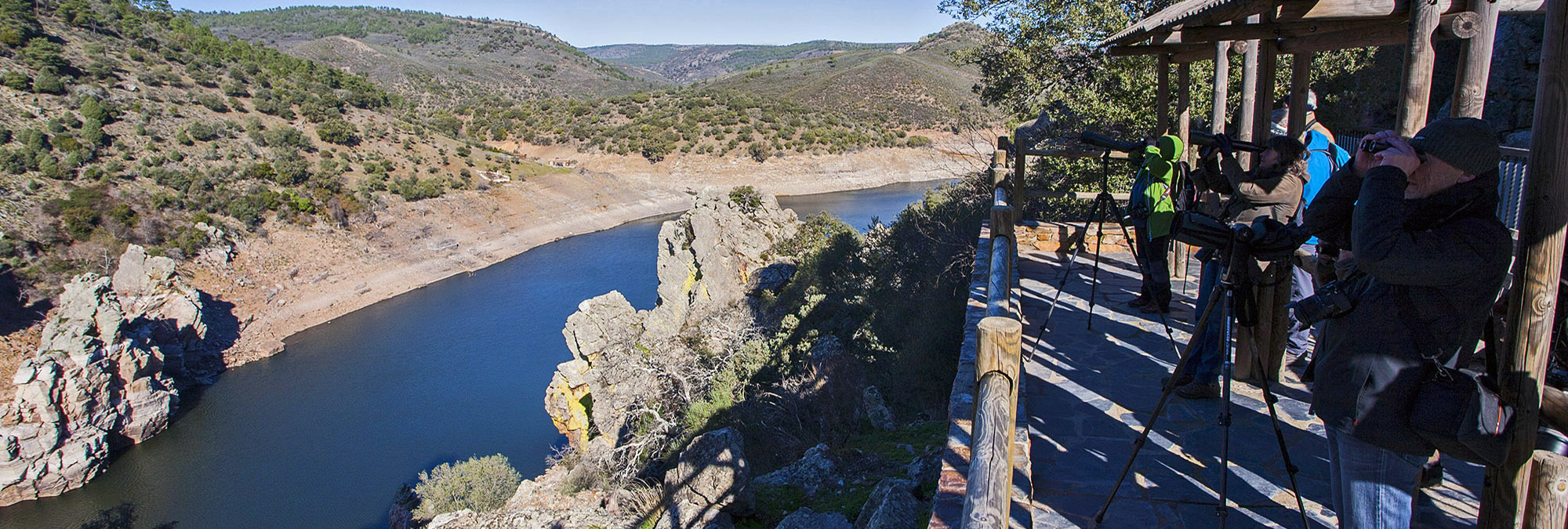
5) Sit in silence and observe, don’t forget your binoculars and camera at home.
6) Stay in one of the local accommodations and enjoy the peace and warm hospitality of the people. Book here at the best price.
7) Taste local food and enjoy traditional dishes from Extremadura gastronomy.
8) Go stargazing on a clear night, don’t forget to dress warmly.
BIODIVERSITY
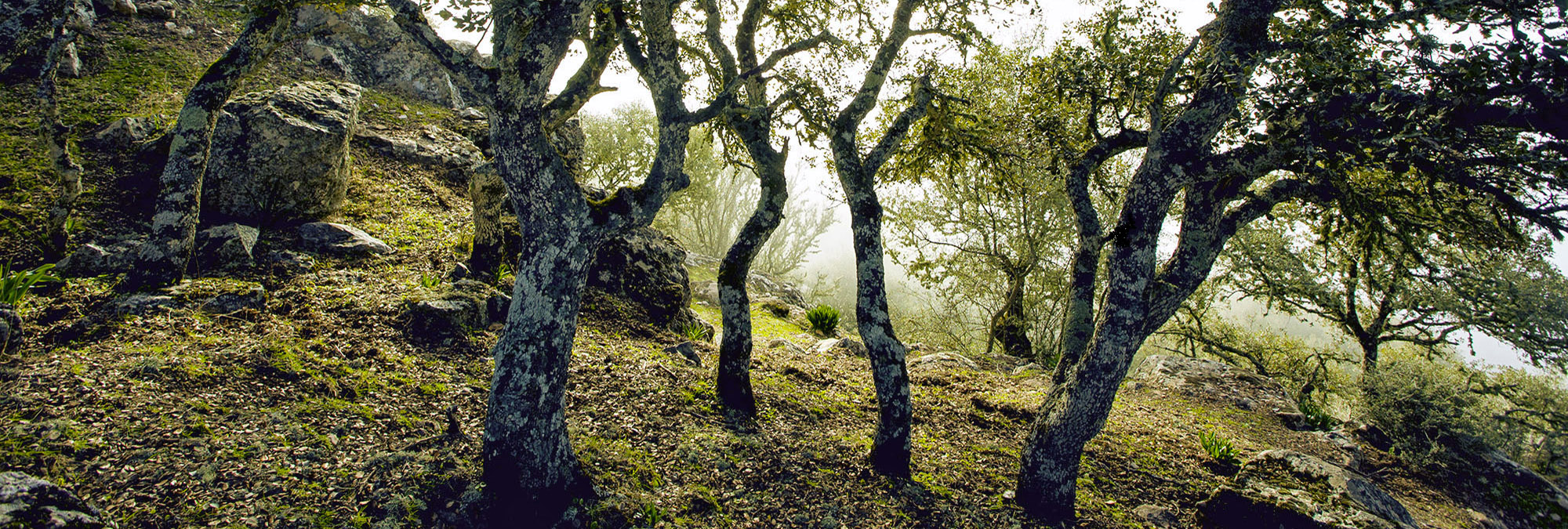
At the confluence of the Tagus and Tiétar rivers lies Monfragüe National Park, a natural area of extraordinary ecological richness where quartzite and slate mountain ranges frame Mediterranean forests, riverbanks, rocky cliffs, streams and reservoirs. This mosaic of ecosystems, one of the best preserved in Europe, attracts nature lovers, hikers, and travelers from all over the world. However, birds are the park’s true stars, making Monfragüe an international benchmark for birdwatching.
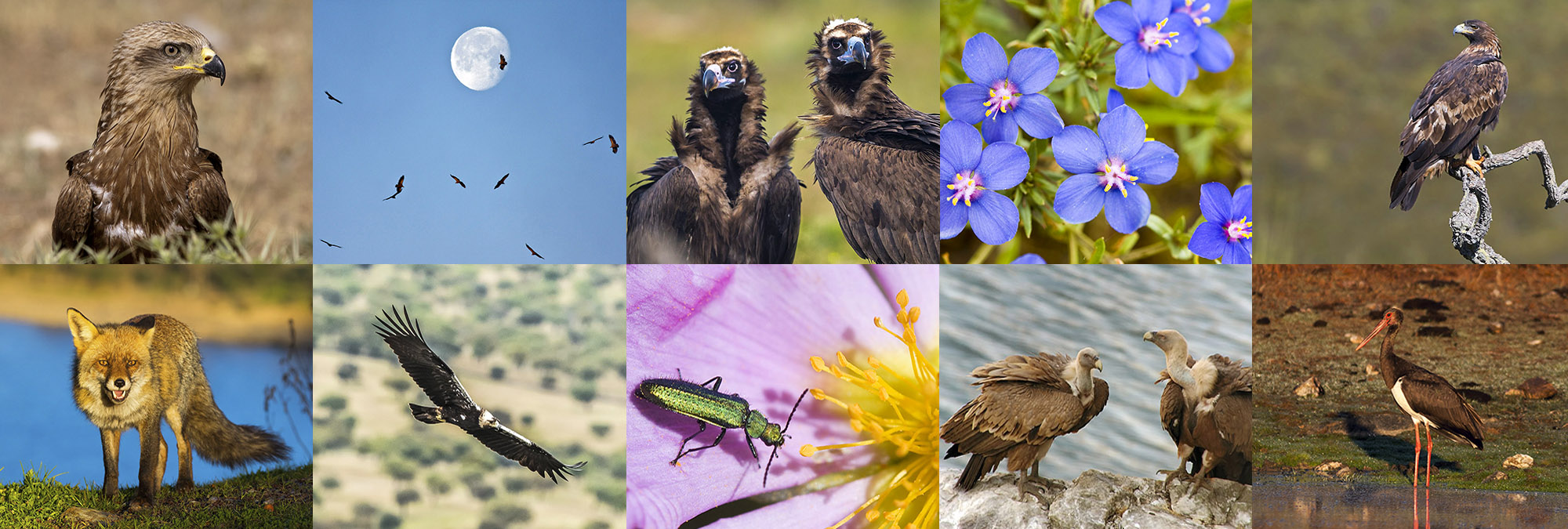
The park is home to more than 280 species of vertebrates, over 200 of which are birds. Particularly noteworthy is the Spanish Imperial Eagle, one of the most endangered birds of prey in the world, with only around 500 breeding pairs globally, 10 of them in Monfragüe. The Black Vulture also stands out, with the largest breeding colony in the world found here, along with other large raptors such as the Golden Eagle, the Egyptian Vulture and the Eagle Owl, as well as the elusive Black Stork and the ever-present Griffon Vultures. Among the smaller birds are distinctive species such as the Azure-winged Magpie and the White-rumped Swift.
The fauna is further enriched by mammals including the Otter, Red Deer, whose autumn rut attracts many visitors, the Wild Boar, and the Wildcat, as well as amphibians, reptiles and a great diversity of invertebrates.
The vegetation reflects the east–west orientation of the mountain ranges, clearly distinguishing the shadier, cooler north-facing slopes, with cork oaks and strawberry trees, from the sunnier south-facing slopes, dominated by holm oaks and aromatic shrubland. On the quartzite ridges grow the juniper and the cenizo, true botanical treasures of Extremadura.
HISTORICAL HERITAGE
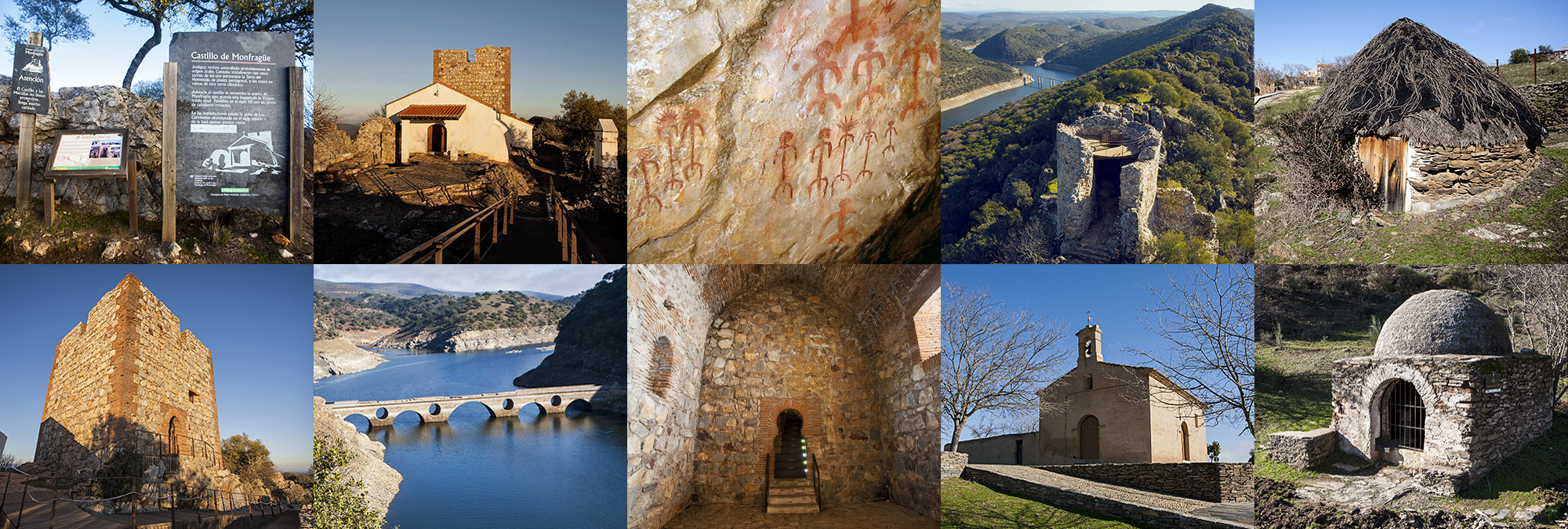
Monfragüe National Park has been inhabited since prehistoric times, as evidenced by the numerous rock paintings preserved in shelters throughout its mountain ranges. After these early settlers, Celtic and Vetton peoples occupied the area until the arrival of the Romans, who named it Monsfragorum, Dense Forest. The Romans introduced new infrastructure such as bridges, roads, fountains and watchtowers and began transforming the Mediterranean forest into dehesa, the traditional agroforestry landscape that has become characteristic of Extremadura.
During the Middle Ages, Muslim inhabitants called the area al-Mofrag, the Abyss, and, in the 9th century, began building the fortress and castle of Monfragüe. Although today only fragments of walls and several restored sections remain, among them the 12th-century round tower and the 15th-century keep, the complex once included two walled enclosures and five towers. Nearby stands the 12th-century Hermitage of the Virgin of Monfragüe.
In the 15th century, the Cardinal’s Bridge was built over the Tagus River by order of Bishop Juan de Carvajal in 1450. Together with the Alcántara Bridge, it was one of only two bridges spanning the Tagus in Extremadura for centuries, making Monfragüe a strategic crossing point for merchants, transhumant shepherds, and travelers. This constant flow of people also attracted bandits, prompting Charles III of Spain in the 18th century to found the small village of Villarreal de San Carlos to improve security.
In the 20th century, the construction of reservoirs and extensive reforestation with pines and eucalyptus dramatically altered the landscape. Thanks to the efforts of conservationists and scientists, Monfragüe was declared a Natural Park in 1979 and later a National Park in 2007, achieving the highest level of environmental protection in Spain.
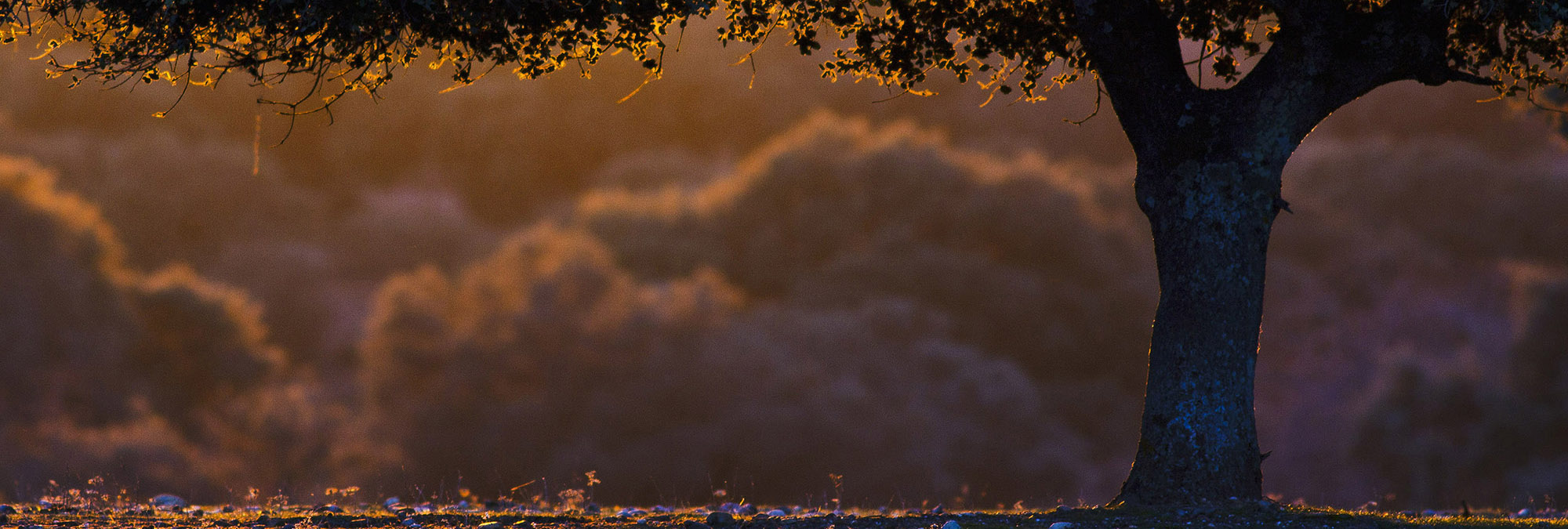
8 THINGS YOU SHOULD KNOW BEFORE VISITING MONFRAGÜE
1) Monfragüe National Park is a protected natural area, respect it and take care of it, it is everyone’s heritage.
2) Before your visit, stop by a tourist office. There you will receive useful information and, if you wish, you can pick up a map.
3) The National Park is always open and access is free.
4) There are two roads that run through Monfragüe, equipped with parking areas. Along these roads you will find some of the best-known viewpoints.
5) There are routes adapted for people with disabilities.
6) Winters are cold and summers are hot, so bring clothing suitable for each season of the year.
7) It is not allowed to feed wild animals, pick plants, leave marked paths, make fires, littering, navigation, swimming, camp freely or overnight caravans parking.
8) Pets are allowed as long as they are kept on a leash and under control.